 |
|

|

|

|
Since a server must communicate with a wide range of clients, it needs to be sure that the client it is talking to can accept the data being sent. Likewise, if a client requests data of a certain type, it must be sure that the server can send that type and that the client knows how to bind to it.
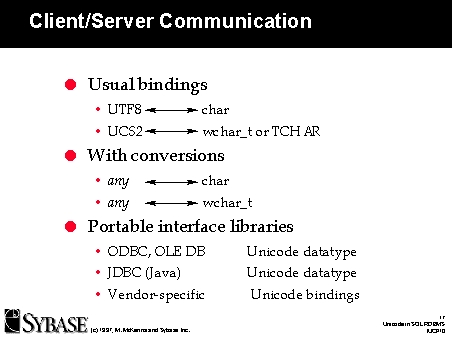
The usual bindings for Unicode are to follow the XPG4 recommendations, binding UTF-7 and UTF-8 data to an 8-bit multibyte character array or string. UCS-2 is bound to a wide character string such as wchar_t or TCHAR.
With conversions, the non-Unicode character sets must be identified and the correct conversion functions invoked for binding to numeric or temporal types.
Portable interface libraries take care of much of the work for client/server negotiation and transparent binding of server data to client variables. Since ODBC and JDBC provide binding directly to Unicode datatypes, it is probable that the proprietary database vendor libraries will support binding to Unicode as well. Microsoft SQL Server Product Manager Peter Hussey recommends writing the application to ODBC not to the database [13]. CLI developers for ODBC and JDBC must make sure that the Unicode bindings work correctly.
|
|
|
|