Technical problems
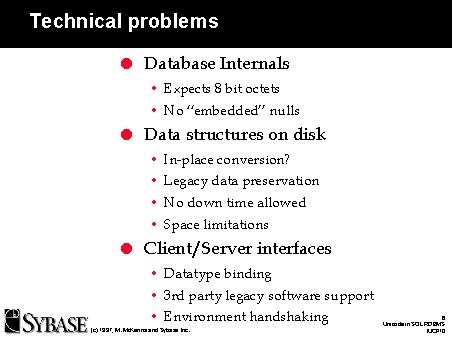
Database Internals
Among the problems that face a systems developer, and to which much
of this conference is addressed, is the conversion of text processing internals
from a model that assumes 8-bits per character and single-byte null-terminated
strings to one that handles Unicode, usually assumed to be proper 16 bit
UCS-2 encoding.The obvious solution is to replace character processing
internals with all Unicode-enabled routines, but this may not be as simple
as it sounds, depending on other technical requirements for that particular
developer or architectural limitations of the product. Some may use UTF-8
for a time, others may move directly to UCS-2.
Data structures on disk
The physical data structures on disk are to a database's anatomy what
bones are to a human's anatomy. It is easier to get a heart transplant
than it is to get a new rib cage or skull. Hence two requirements appear
for existing installations that are to be upgraded: the preservation of
legacy data, and minimising the upgrade time.Three scenarios are appearing
in the industry to accomplish this: create a separate Unicode-only installation,
create a parallel Unicode-only database, or allow Unicode as a separate
datatype different from existing character datatypes. Enabling customers
to do in-place conversion of existing data must be considered as well.Some
vendors have particularly stringent space limitations, so compression of
Unicode becomes an issue.
Client/Server interfaces
Database providers must decide whether and how to bind Unicode to existing
datatypes (int, char, date, etc.) and how to bind existing datatypes back
to Unicode. Implicit conversions (what the SQL standard calls "coercibility")
as well as explicit conversions must be considered. Since Unicode may be
used in a native word format on the CPU, byte-swapping must be considered.
Once Unicode is implemented, 3rd party legacy software must still be supported,
with Data being sent from a server appropriately converted to datatypes
and encodings the older clients can understand. The client software must
be able to properly communicate to the server what the session's cultural
environment or locale is.Designing to ODBC and JDBC or client interfaces
such as Open Client or SQL*Net address many of these issues. Vendors must
support their own proprietary data and network protocols.